
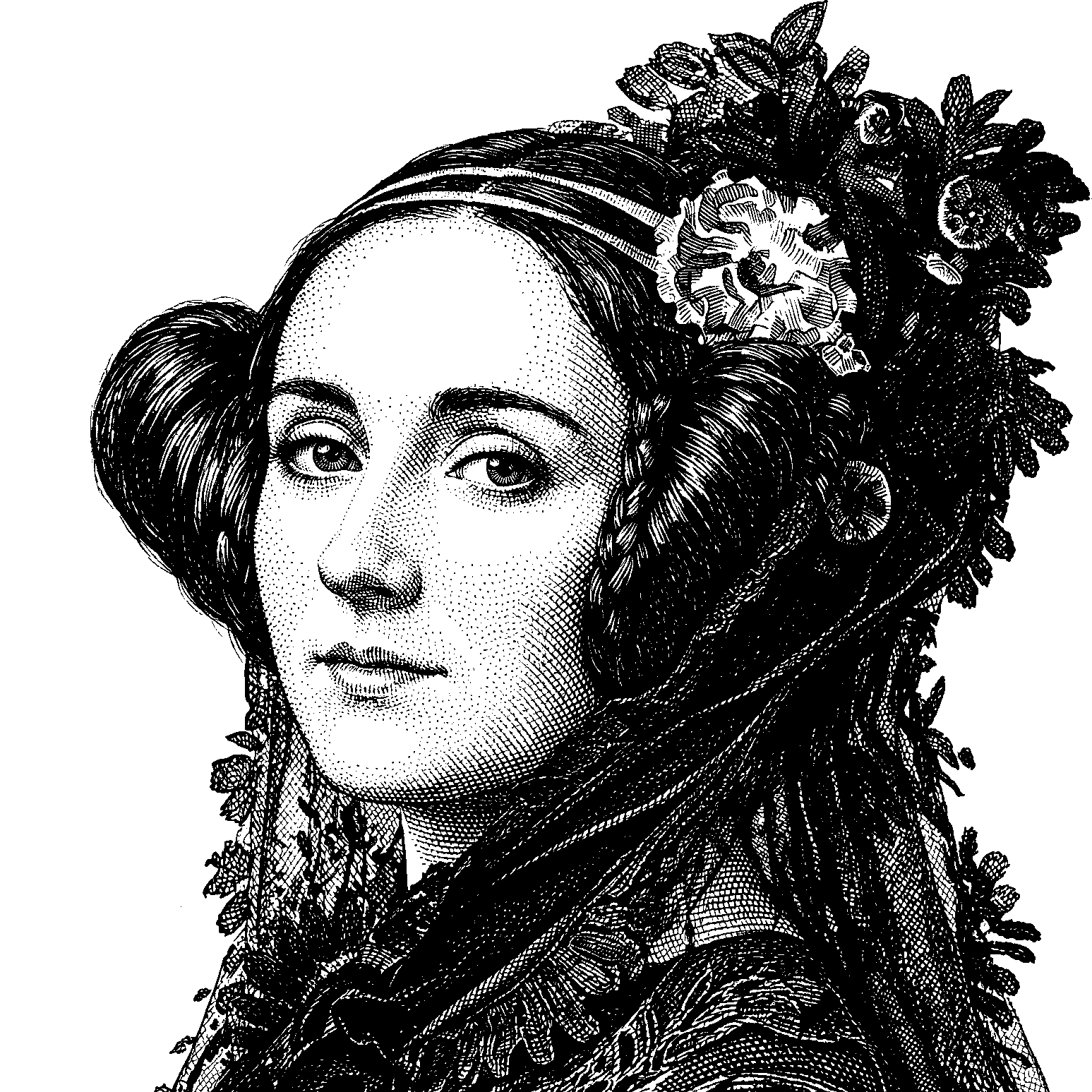
Augusta Ada King, Countess of Lovelace, was an English mathematician and writer who is widely regarded as the first computer programmer. Born Ada Gordon, the sole child of the poet Lord Byron and his mathematics-loving wife Annabella Milbanke, she was raised under a strict regimen of science and mathematics to counteract any inherited poetic temperament.
Educated privately by William Frend, William King, and the noted scientific author Mary Somerville, Lovelace’s mathematical talents led her at age seventeen to a lifelong friendship and working relationship with Charles Babbage, inventor of the Difference Engine and Analytical Engine. In 1842, she translated an article about Babbage’s Analytical Engine by the Italian mathematician Luigi Menabrea, supplementing it with extensive notes that tripled its length.
Lovelace’s notes contained what is recognized as the first algorithm intended for implementation on a machine—a method for calculating Bernoulli numbers—earning her the title of the world’s first computer programmer. More significantly, she was the first to recognize that the machine had applications beyond pure calculation. She envisioned encoding and manipulating information such as music, anticipating by more than a century the modern understanding of computers as general-purpose symbol processors.
Though her contributions were largely forgotten after her death from uterine cancer at age 36, Lovelace’s legacy was rediscovered in the twentieth century. The programming language Ada was named in her honor, and the second Tuesday of October is now celebrated as Ada Lovelace Day, honoring women’s contributions to science, technology, engineering, and mathematics.