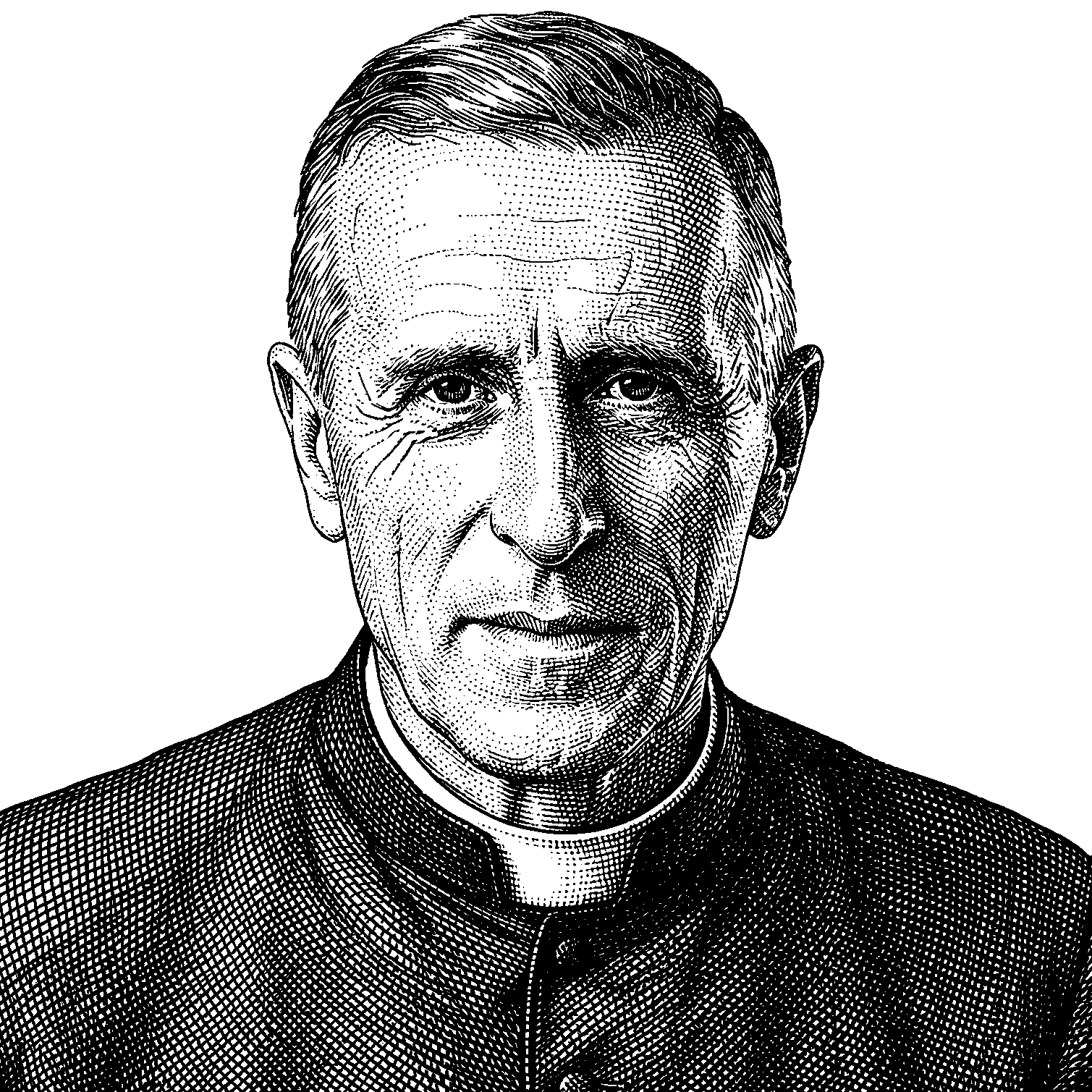
Pierre Teilhard de Chardin (1 May 1881 – 10 April 1955) was a French Jesuit priest, paleontologist, philosopher, and mystic whose synthesis of science and Christian faith profoundly influenced twentiethcentury religious thought. Born in Auvergne, France, he was distantly related to both Voltaire and Blaise Pascal.
Teilhard joined the Jesuit order in 1899 and was ordained to the priesthood in 1911. During World War I, he chose to serve as a stretcher bearer rather than a chaplain, earning the Legion of Honour for his courage. His paleontological work took him to China, where he participated in the 1929 discovery of Peking Man (Homo erectus pekinensis), establishing its geological era at approximately 750,000 years ago.
His major works, The Divine Milieu and The Phenomenon of Man, written in the 1920s and ’30s, were forbidden publication during his lifetime by Jesuit authorities due to his evolutionary reinterpretation of Christian doctrine. Teilhard developed the concept of the Omega Point—a theorized future event toward which the universe spirals in increasing complexity and consciousness, which he identified with Christ. Along with Vladimir Vernadsky, he contributed to developing the concept of the noosphere—a sphere of human thought encircling the earth.
Teilhard’s earthaffirming theology has grown in acceptance since his death, influencing Vatican II’s “The Church in the Modern World” and being cited by Pope Francis in Laudato si’. His vision of cosmic evolution toward divine unity resonates deeply with transhumanist themes of human transformation and technological transcendence.